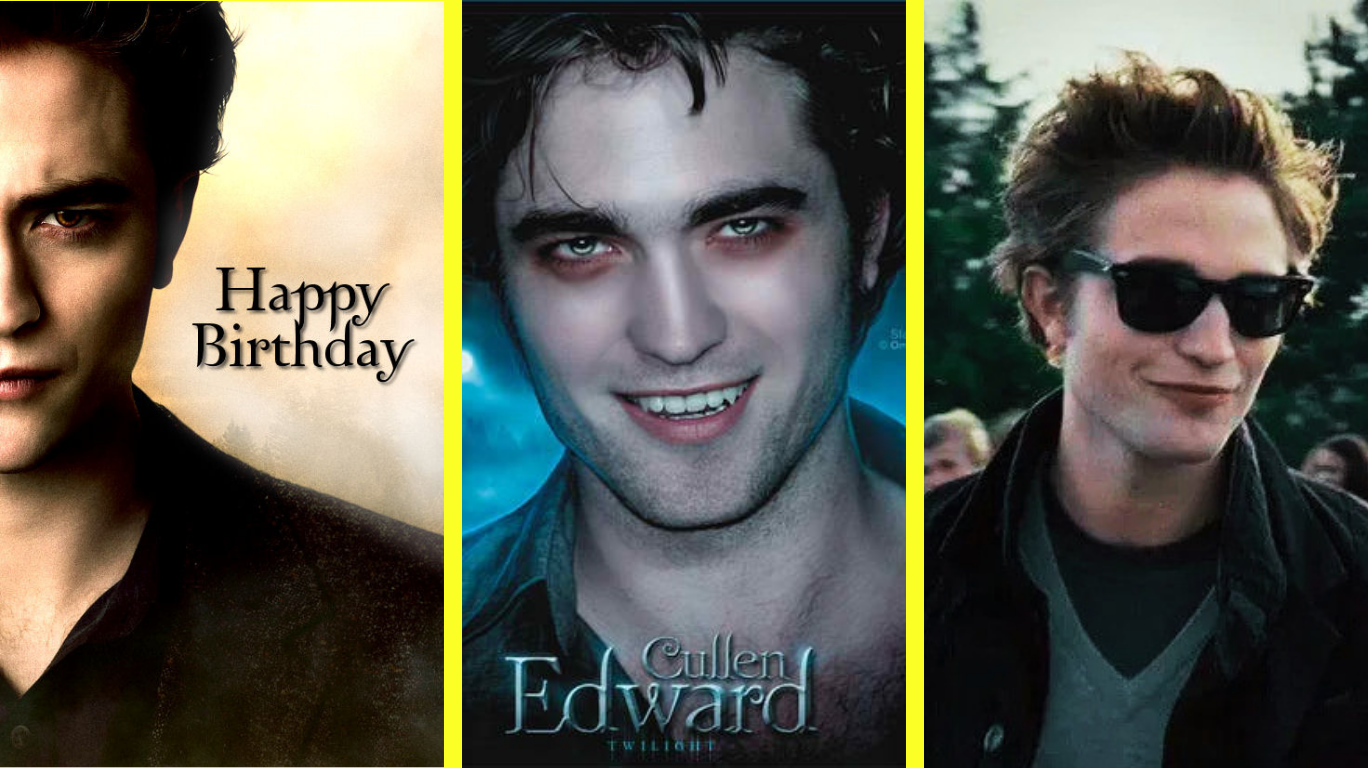
Few fictional characters have captured the imagination of an entire generation the way Edward Cullen has. He is brooding yet tender, dangerous yet devoted, immortal yet deeply human at heart. Since Stephenie Meyer introduced him to the world in her 2005 novel Twilight, Edward has become one of the most recognizable vampires in the history of popular fiction — and one of the most debated romantic leads ever written.
But who exactly is Edward Cullen beyond the pale skin, golden eyes, and smoldering stares? The answer is far more layered than most people realize. Born in 1901 as a human boy in Chicago, transformed into a vampire at just 17 years old during one of history’s deadliest pandemics, and shaped by over a century of lived experience, Edward is a character with genuine depth. This article covers everything you need to know about Edward Cullen — his age, birthday, powers, human backstory, vampire transformation, personality, family, love story, and lasting cultural legacy.
Who Is Edward Cullen? A Quick Character Overview
Edward Cullen, born Edward Anthony Masen Jr., is the central male character of Stephenie Meyer’s Twilight Saga — a four-book series that became a global phenomenon and one of the best-selling young adult franchises of all time. Edward first appeared in Twilight (2005) and went on to feature prominently in all four main novels: Twilight, New Moon, Eclipse, and Breaking Dawn. In 2020, Meyer released Midnight Sun, a full retelling of the original Twilight story told entirely from Edward’s perspective — giving fans an unprecedented look inside his mind.
In the film adaptations (2008–2012), Edward was brought to life by British actor Robert Pattinson, whose performance made him an international star virtually overnight. Edward serves as the male romantic lead of the series and the primary love interest of protagonist Bella Swan. Their relationship — intense, complicated, and often dangerous — forms the emotional backbone of the entire saga.
What makes Edward resonate so strongly with readers is a deceptively simple idea: here is a vampire who has every reason to give in to his darkest instincts, yet chooses love, restraint, and morality instead. That internal struggle between what he is and what he chooses to be is what elevates him above the typical vampire archetype and keeps fans coming back to his story decades after it was first told.
Edward Cullen Age and Birthday — How Old Is He Really?
This is one of the most frequently asked questions about the character, and the answer has two very different layers.
Edward Cullen was born on June 20, 1901, in Chicago, Illinois. That makes him a Gemini — a fitting sign for someone who carries such a profound duality within him. He was 17 years old when he was transformed into a vampire in 1918, during the catastrophic Spanish Influenza pandemic that swept across the globe and killed tens of millions of people.
Here is where the fascinating paradox begins. Physically, Edward is permanently frozen at 17. His body will never age, never change, never grow older. From the outside, he looks like a teenage boy. But when the events of Twilight take place in 2005, Edward has actually been alive for approximately 104 years. He has lived through World War I, the Great Depression, World War II, the Cold War, the moon landing, the rise of the internet, and countless other seismic shifts in human history — all while appearing to be a high school junior.
So is Edward still mentally 17? Absolutely not. He has a century’s worth of lived experience, education, loss, and growth packed behind those amber eyes. He has attended university multiple times, read more books than most humans could in ten lifetimes, and developed a philosophical complexity that no actual teenager could possess. His body is 17. His soul is ancient. That tension is central to who he is.
His birthday, June 20, is still celebrated annually by fans around the world — a tradition that speaks to how alive this character remains in the collective imagination.
Edward Cullen’s Human Life — Before He Became a Vampire
To understand Edward Cullen fully, you have to start before the fangs, before the speed, before the immortality. You have to start with Edward Anthony Masen Jr., a boy growing up in early twentieth-century Chicago.
Edward was born into a comfortable, upper-middle-class family. His father was Edward Masen Sr., and his mother, Elizabeth Masen, was a devoted and deeply loving woman. By all accounts, Edward had a privileged and stable childhood. He was intelligent beyond his years, sensitive, and showed an early and remarkable gift for music — the piano in particular became his passion, an outlet for an emotional depth that had no other place to go.
As a teenager in 1917, Edward was caught up in the patriotic fervor surrounding World War I. He desperately wanted to enlist and serve his country, but was too young to do so. That frustrated desire to be part of something larger than himself, to fight for a cause, is something that would define his character long after the war ended and long after his human life was over.
Then, in 1918, everything changed. The Spanish Influenza tore through Chicago with devastating force. Edward’s father was among the first to fall ill, and he died quickly. His mother, Elizabeth, contracted the virus shortly after. As she lay dying in the hospital where a young Dr. Carlisle Cullen worked, she made a desperate, almost inexplicable plea to the doctor: “Save him. Do what you must.” Whether she somehow sensed what Carlisle truly was, or whether she was simply a mother begging for a miracle, is left deliberately ambiguous. But her words set everything in motion.
Edward himself fell gravely ill. At 17, brilliant and full of unlived life, he was dying. And Carlisle — bound by compassion and moved by those dying words — chose to save him in the only way he could.
Edward Cullen’s Vampire Transformation — The Origin Story
Dr. Carlisle Cullen is one of the oldest and most unusual vampires in the Twilight universe. Born in London in 1640, he was turned into a vampire in 1663 after being attacked by an ancient vampire while hunting creatures of the night alongside his father. Carlisle spent the following centuries cultivating an extraordinary degree of self-control and developing a philosophy that went against everything conventional vampire lore suggested: he believed that vampires could choose to be good. They did not have to prey on humans. They could live among people, help people, love people — if they had the willpower and the moral conviction to do so.
When Carlisle transformed Edward in 1918, he was not acting impulsively. He was extending his philosophy of chosen goodness — offering a dying boy the chance to continue existing, on the condition that existence would be shaped by the same values Carlisle had spent centuries building.
The transformation itself is described in the Twilight universe as one of the most painful experiences imaginable — a burning sensation that spreads through every cell of the body over the course of several days as the venom replaces human blood. Edward emerged from that process no longer human, but not yet the man he would eventually become.
The early years after his transformation were turbulent. Edward struggled profoundly with what he now was. The thirst for human blood was overwhelming, and unlike Carlisle, he had not had centuries to build his resistance. In 1927, Edward broke away from Carlisle’s way of life entirely. He convinced himself that if he only fed on murderers, criminals, and genuinely evil people — rapists, abusers, killers — he could justify his nature. He became a vigilante predator, using his telepathy to identify society’s worst and feeding on them exclusively. His first victim was Charles Evenson, Esme’s abusive ex-husband. For several years he lived this way, hunting the darkest corners of humanity rather than innocent people.
But the moral compromise did not bring him peace. It brought guilt — compounded by the fact that his telepathy meant he heard every thought of his victims as they died. By 1931, Edward returned to Carlisle, chastened and more deeply committed than ever to the “vegetarian” lifestyle — meaning they fed exclusively on animal blood, never human. That dark chapter is crucial to understanding his character. Edward is not simply good by default. He chose goodness, deliberately and painfully, after having tasted the alternative.
Edward Cullen’s Powers and Abilities — What Makes Him Special?
Edward Cullen is a formidably gifted vampire, and his abilities set him apart even within the already extraordinary Cullen family.
Superhuman Speed is his most notable physical gift. Edward is the fastest vampire in the Cullen coven — faster even than Carlisle or Emmett. He can cover vast distances in seconds and move so quickly that humans cannot track him with the naked eye. In the films, this speed is most memorably displayed when he crosses a school parking lot in an instant to stop a skidding van from crushing Bella.
Superhuman Strength comes standard with vampirism in Meyer’s universe, and Edward is exceptionally strong — capable of stopping a moving vehicle, crushing metal, and fighting other vampires with devastating force. That said, he is not the physically strongest member of the family. That distinction belongs to Emmett Cullen, who possesses raw power that even Edward cannot match. Edward compensates for this in combat through his speed and his unique ability to anticipate an opponent’s moves.
Enhanced Senses mean that Edward can hear conversations from a significant distance, detect human scents from miles away, and process visual information with extraordinary clarity. These heightened senses are both a gift and a burden — the smell of human blood, for instance, is a constant temptation that requires relentless self-discipline to resist.
Telepathy is Edward’s signature supernatural ability, and the one that most defines his character. He can read the thoughts of virtually every person in his vicinity. This power has made him extraordinarily perceptive over the decades — he has had access to the inner lives of thousands of people, which has deepened his understanding of human nature in ways that go far beyond ordinary experience. It has also, paradoxically, made him deeply lonely. Hearing what everyone around you truly thinks is not a gift that lends itself to genuine connection.
Which brings us to the most important exception: Bella Swan. Edward cannot read Bella’s mind. Her thoughts are completely silent to him — the first time in his long existence that he has encountered a person he simply cannot hear. This is not a small thing. For someone accustomed to instant, involuntary access to everyone’s inner world, Bella’s silence is startling, frustrating, fascinating, and ultimately irresistible.
Immortality means Edward does not age, does not sleep, does not require food or water (only blood), and cannot be killed by conventional means. In Meyer’s mythology, vampires are also remarkably resilient — their bodies are harder than stone and nearly indestructible except by other vampires or supernatural forces.
One notable departure from traditional vampire lore: Edward does not burn in sunlight. Instead, direct sunlight causes his skin to sparkle like diamonds — a visual effect that is beautiful but conspicuous enough to make daylight exposure in public a problem, which is why the perpetually overcast skies of Forks, Washington make it the perfect place for the Cullen family to live.
Edward Cullen’s Personality — The Man Behind the Vampire
Reducing Edward Cullen to “brooding romantic vampire” is a significant disservice to one of fiction’s more genuinely complex characters. Yes, he broods. But the reasons behind that brooding are worth exploring.
At his core, Edward is fiercely protective. He would do anything — including removing himself from Bella’s life entirely — to keep her safe. This protective instinct sometimes tips into controlling behavior, which is a legitimate criticism that fans and scholars have raised over the years, and it is worth acknowledging. His overprotectiveness is a flaw, rooted in his deep fear of causing harm.
He carries a profound self-loathing that colors almost every decision he makes. Edward genuinely believes he is a monster — not metaphorically, but literally. He has taken human lives, even if those lives belonged to criminals. He is a predator by nature. The tension between what he is and what he wants to be creates a constant internal war that makes him simultaneously sympathetic and tragic.
What often surprises people when they look more closely at the character is how intellectually formidable he is. Edward has used his century of existence well. He holds two graduate degrees and has attended medical school twice, following in Carlisle’s footsteps. He is deeply well-read, musically accomplished — he plays the piano at a virtuoso level and composed an original piece, Bella’s Lullaby, specifically for her — and has a philosophical sophistication that comes from genuinely living through history rather than reading about it.
His manners and values are distinctly early twentieth century, which creates a fascinating friction with the modern world he inhabits. He is chivalrous in ways that can feel anachronistic. He holds doors, speaks carefully, takes commitments with absolute seriousness. For Bella, this old-fashioned quality is part of his appeal. For readers, it adds a layer of authenticity to a character who genuinely would have been shaped by the era in which he was born.
Edward also has a dry wit that is easy to miss if you are focused only on the more dramatic moments. He teases Bella with a lightness that reveals the warmer, more playful side of a personality that has been defined by isolation and restraint for too long.
When contrasted with Jacob Black — warm, impulsive, passionately human — Edward represents something different: the choice to contain power, to prioritize safety over passion, to love someone so much that you are willing to deny yourself. Whether that reads as noble or suffocating depends on the reader, but it is never simple.
Edward Cullen’s Family — The Cullen Coven
One of the most quietly remarkable things about Edward Cullen’s story is that he found — or rather, was given — a family. And over more than eighty years, that family became the foundation of everything he is.
Dr. Carlisle Cullen is both the patriarch of the family and the man who made Edward’s existence possible. Their relationship goes far beyond creator and creation. Carlisle is a father in every meaningful sense — a steady moral compass, a source of unconditional acceptance, and the person who showed Edward that being a vampire did not have to mean being a monster.
Esme Cullen, Carlisle’s wife, is the warm center of the family. Transformed after surviving a tragic human life, Esme channels all of her considerable love into her adopted family. She was the mother Edward never had a chance to grow up with, and their bond reflects that.
Among his siblings, Edward is closest to Alice — a small, luminously joyful vampire who can see glimpses of the future. Alice’s gift for seeing possibilities rather than certainties means she and Edward are natural allies, their complementary powers giving the family a significant tactical advantage. Jasper Hale, Alice’s partner, can sense and influence the emotions of those around him. His presence helps regulate the emotional intensity that Edward and others sometimes carry.
Rosalie Hale has the most complicated relationship with Edward among the siblings. She initially resents Bella’s entrance into their world — partly out of jealousy for Bella’s humanity, which Rosalie desperately wishes she still possessed, and partly out of genuine fear for what Bella’s presence means for the family’s safety. Their dynamic thaws over time but never becomes entirely easy.
Emmett Cullen, the physically strongest and most exuberantly cheerful of the family, is a grounding presence. His lightness of spirit serves as a counterweight to Edward’s intensity, and their dynamic has a brotherly warmth that is one of the more endearing relationships in the saga.
The Cullen family practices the “vegetarian” lifestyle — subsisting on animal blood, never human. They move every several years to avoid the scrutiny that comes with never visibly aging. During the events of the Twilight series, they have settled in Forks, Washington, drawn by the region’s consistent cloud cover and its small, relatively isolated community.
Edward Cullen and Bella Swan — The Central Love Story
The first time Edward encountered Bella Swan in the halls of Forks High School, he nearly killed her. Not through violence, but through irresistible compulsion. Bella’s blood called to Edward with a force he had never experienced in over a century of existence — a phenomenon sometimes called being someone’s “singer” in the Twilight universe, meaning one person’s blood is uniquely, overwhelmingly appealing to a specific vampire.
Edward’s initial response was not attraction. It was barely contained horror at his own reaction. He requested an immediate class transfer. He considered leaving Forks entirely. He sat as far from Bella as he could and white-knuckled his way through every proximity to her. The irony that would shape the entire saga was already taking root: the person he most needed to avoid was the person he would come to love most in the world.
His fascination deepened when he realized he could not hear her thoughts. After years of involuntary access to everyone around him, Bella’s mental silence was a puzzle he could not solve and could not stop thinking about. She was, for the first time, a genuine mystery.
Their relationship developed through conversations — in classrooms, forests, Bella’s truck, the hospital — building a foundation of trust and intellectual connection before the romantic intensity took over fully. When Edward revealed the truth of what he was, Bella’s response was not fear but a kind of quiet acceptance that moved him profoundly. She was not afraid of the monster. She saw the man.
The central tension of their relationship is stated plainly in the first book and never fully resolved until the last: Edward loves Bella enough to want to be with her, and loves her enough to know he might destroy her. That contradiction drives everything. It drives his protectiveness, his self-denial, and the decision in New Moon to leave Forks entirely after a birthday party incident nearly ends with his brother attacking her. His departure devastates Bella in one of the saga’s most emotionally brutal sequences, and it costs Edward nearly everything.
They find their way back to each other, survive werewolves and rival vampire covens and Edward’s own darkest impulses, and eventually marry in Breaking Dawn. Bella is transformed into a vampire at her own insistence. Together they have a daughter — Renesmee, a half-human, half-vampire hybrid — whose existence becomes the final great conflict of the saga. Their story ends, improbably and beautifully, with both of them getting everything.
Edward Cullen in the Movies — Robert Pattinson’s Portrayal
When it was announced that British actor Robert Pattinson would play Edward Cullen in the 2008 film adaptation of Twilight, the reaction from the fanbase was far from welcoming. Pattinson was largely unknown outside of a supporting role in Harry Potter and the Goblet of Fire, and devoted readers of the books had very specific ideas about what Edward should look and feel like. Online petitions against his casting circulated before the film had even begun shooting.
What happened next is worth appreciating. Pattinson showed up, committed completely, and made the role his own. The iconic cafeteria entrance scene — where Bella sees Edward for the first time — became one of the most memorable character introductions in modern franchise cinema, achieved not through CGI but through precise makeup work, lighting design, and Pattinson’s own carefully controlled physical presence. He embodied Edward’s otherworldliness with an intensity that silenced most of the early skeptics.
What is perhaps most impressive in retrospect is that Pattinson brought genuine craft to a role that could easily have been played as pure romantic archetype. He found the self-loathing, the exhaustion, the weight of immortality underneath the love story and made those things visible. He played the role, as one fan put it, with the same commitment he brings to his most serious dramatic work.
After Twilight, Pattinson made a series of deliberate, calculated choices to move as far from the franchise as possible — collaborating with unconventional directors, taking difficult and physically demanding roles, actively avoiding anything that resembled mainstream Hollywood comfort. Good Time, The Lighthouse, Tenet, and ultimately The Batman constituted a career reinvention that earned him serious critical recognition. None of it erased Edward Cullen from his legacy. Instead, it reframed the Twilight performance as the beginning of a genuine acting career rather than a fluke of franchise casting.
Edward Cullen’s Legacy — Why He Still Matters
Nearly two decades after Twilight first introduced him to the world, Edward Cullen is not a relic. He is still being discovered, still being debated, and still inspiring passionate responses from new generations of readers and viewers.
The “For You Page” effect on TikTok and Instagram has introduced the Twilight Saga to audiences who were not old enough to experience it the first time around. Fan edits, clip compilations, and earnest discussions about Edward and Bella’s relationship regularly go viral. The r/twilight community on Reddit remains active and engaged. Stephenie Meyer’s Midnight Sun, released in 2020, gave longtime fans an entirely new way into a story they thought they knew completely.
Edward endures because he represents something that fantasy storytelling does not always get right: a genuinely dangerous figure who is also genuinely good. Not sanitized. Not defanged. Good in the specific, hard-won way that requires constant choice and constant cost. That archetype — the monster who chooses love, who chooses restraint, who chooses to be better than what he is — is one that human beings across cultures and generations seem to need.
The “Team Edward vs. Team Jacob” debate, which began as a marketing hook and became a genuine cultural phenomenon, is still alive because both positions have real merit. Edward offers devotion, protection, and a love built on deep knowledge of another person. Jacob offers warmth, humanity, and a love without the existential threat. The fact that people still argue about this twenty years later is not trivial. It speaks to how fully realized both characters are.
His birthday, June 20, is still celebrated annually online. Discussions of potential reboots or new streaming adaptations keep the character in active circulation. Whatever form the Twilight story takes in the years ahead, Edward Cullen’s place in the cultural landscape seems secure.
Conclusion
Edward Cullen’s story is, at its heart, a story about choice. He was not born a vampire. He did not choose to be transformed. He did not ask for telepathy or immortality or the curse of finding human blood irresistible. What he chose — over and over again, across more than a century — was to be better than his nature demanded.
From a privileged boy in early twentieth-century Chicago to a vampire shaped by decades of isolation, guilt, chosen family, and ultimately love, Edward’s journey is richer and more emotionally honest than the franchise’s romantic surface sometimes suggests. His powers are extraordinary. His backstory is tragic. His personality is layered in ways that reward close attention. And his love story with Bella Swan, for all the criticism it has received over the years, is built on something genuine — two profoundly lonely people who found, in each other, the one thing they had stopped believing they would ever have.
Whether you have loved Edward Cullen since 2005 or you are meeting him for the first time, there is more to discover here than you might expect. The boy who was frozen in time at 17 has been quietly, stubbornly, defiantly living ever since.
Are you Team Edward? Let us know in the comments below.
Frequently Asked Questions
How old is Edward Cullen? Edward Cullen was born on June 20, 1901, making him over 100 years old chronologically. His body, however, is permanently frozen at 17 — the age at which he was transformed into a vampire in 1918 during the Spanish Influenza pandemic. He is simultaneously one of the youngest-looking and oldest characters in the saga.
What are Edward Cullen’s powers? Edward’s most distinctive power is telepathy — the ability to hear the thoughts of nearly everyone around him. He also possesses superhuman speed (the fastest in the Cullen family), superhuman strength, dramatically enhanced senses including hearing and smell, exceptional combat skills, and full immortality. His one notable limitation is that he cannot read Bella Swan’s mind.
Who turned Edward Cullen into a vampire? Edward was transformed by Dr. Carlisle Cullen in 1918. Carlisle was working as a doctor during the Spanish Influenza outbreak in Chicago when Edward and his parents fell ill. After Edward’s parents died and Edward himself was near death, Carlisle transformed him — partly at the desperate request of Edward’s dying mother, and partly out of his own deep compassion.
Why can’t Edward read Bella’s mind? Bella possesses a natural psychic shield that prevents Edward’s telepathy from accessing her thoughts. This ability is an innate part of who she is, even as a human. After she becomes a vampire in Breaking Dawn, her shield becomes a fully developed supernatural power that she can project outward to protect others as well.
Who plays Edward Cullen in the movies? British actor Robert Pattinson portrays Edward Cullen in all five Twilight Saga films, from Twilight (2008) through The Twilight Saga: Breaking Dawn – Part 2 (2012). His casting was controversial when announced but is now widely regarded as one of the defining performances of the franchise.
Is Edward Cullen the strongest vampire in the Cullen family? No. Edward is the fastest member of the Cullen family, but the physically strongest is Emmett Cullen. In combat, Edward compensates for this difference through his speed and his telepathy — being able to anticipate what an opponent is about to do before they do it gives him a significant tactical advantage.
Does Edward Cullen have any weaknesses? In Stephenie Meyer’s vampire mythology, Edward does not have the traditional weaknesses associated with vampires in folklore — sunlight does not burn him, garlic has no effect, and religious symbols hold no power over him. Direct sunlight causes his skin to sparkle visibly, making public exposure impractical. He can be seriously harmed or killed by other vampires or supernatural forces, but is otherwise extraordinarily durable.
What is Edward Cullen’s real name? Edward was born Edward Anthony Masen Jr. After being transformed by Carlisle Cullen and adopted into his family, he took the surname Cullen — the name by which he is known throughout the saga and in popular culture.
Does Edward Cullen have a child? Yes. In Breaking Dawn, Edward and Bella have a daughter named Renesmee Cullen. Renesmee is a rare half-human, half-vampire hybrid, born before Bella’s transformation into a vampire. Renesmee’s existence triggers the final major conflict of the saga, as the Volturi misidentify her as an illegally created immortal child.
What is Edward Cullen’s star sign? Edward Cullen is a Gemini, born on June 20, 1901. The duality associated with that sign — two sides, two natures — fits the character with an almost deliberate precision.
Read More Blog:
visite bulk viewer
Who Is Stuart Claxton?